
Emergency Medicine Core Competences
Format
This precourse is offered in a hybrid format, which means there will be virtual sessions ahead of the live session at the congress:
Monday 21 September From 18:00 to 20:00 CEST: EKG Interpretation (Virtual session)
Tuesday 22 September From 18:00 to 20:00 CEST: Acid-Base Interpretation (Virtual session)
Followed by a face-to-face meeting in room 152, at Palais des Congrès de Paris, France on Thursday 24 September: From 8:30 to 18:15
Overview
OVERVIEW Brief description of course format and/or content:
This hybrid course consists of
1-virtual sessions focussing on EKG and Acid-Base interpretation
2-live sessions focussing on
a) the team management of critically ill patients
b) differential diagnosis and decision-making
c) the neurological examination and interpretation of findings
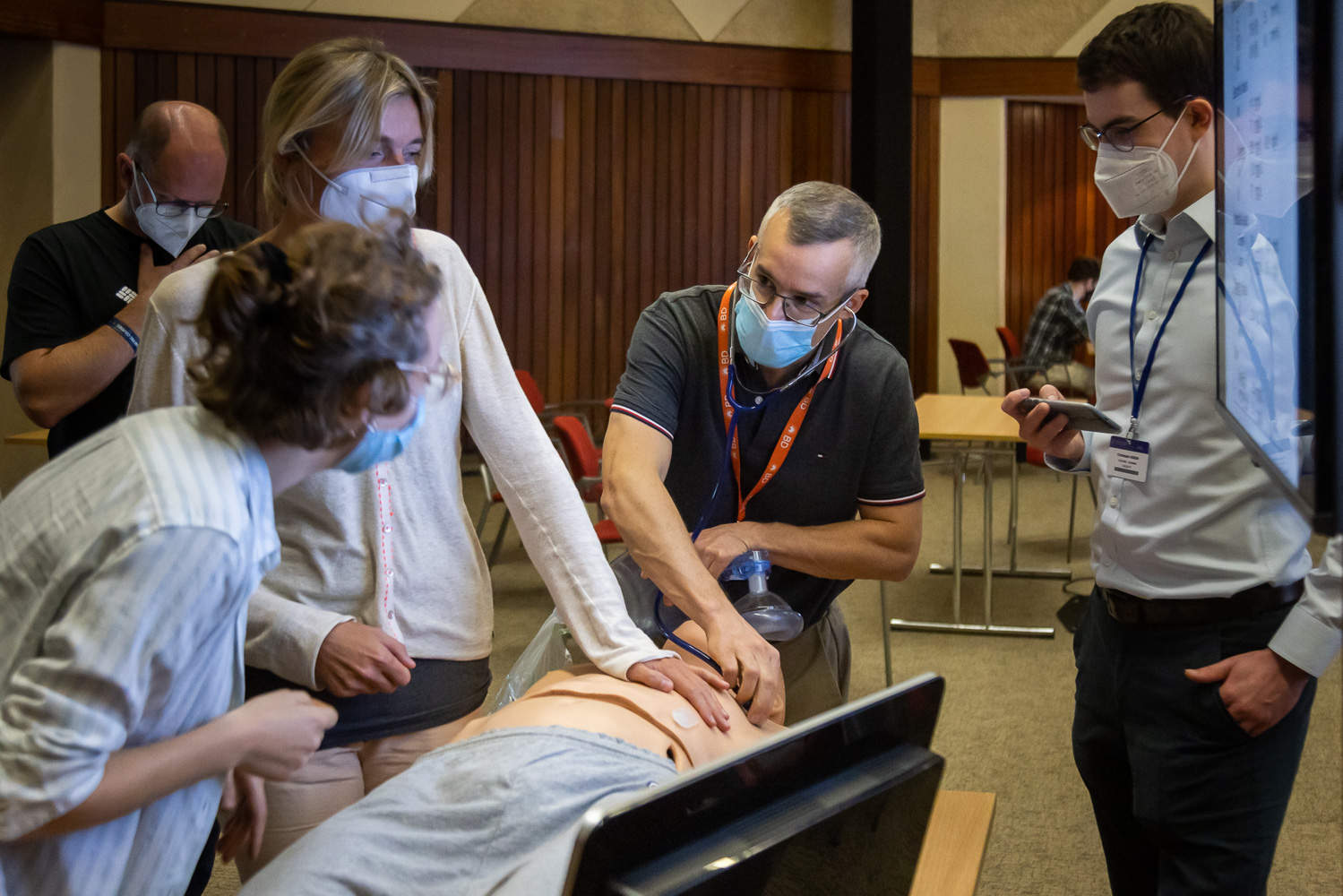
All sessions prioritize scenario-based training. The course also includes brief lectures and a group-discussion period. The unique feature of the course is that it focusses on an integration of information obtained from the history, physical examination findings, EKG, bedside blood tests and point-of-care ultrasound to guide patient management
This course has been accredited by EACCME® and awarded a total of 8 CME credits.
Objectives
OBJECTIVES Brief description of course objectives:
This course focuses on competence development through scenario-based training. The competences in focus are:
1-The initial management of critical patients in all age groups
2-Differential diagnosis and decision-making
3-Systematic EKG interpretation
4-Systematic acid-base interpretation
5-Interpretation of the neurological examination and initial management of selected neurological conditions
Participants hone their ability to integrate information from the history, physical examination, point-of-care ultrasound images, bedside blood test results and the EKG to assess the likelihoods of different time-sensitive conditions and guide initial management. The precourse touches on and links many of the items in the syllabus of the revised European Training Requirements for the Specialty of Emergency Medicine.
Participants receive a checklist compendium that helps guide the initial management of critical syndromes (e.g. anaphylaxis, hemorrhagic shock, hyponatremic encephalopathy) and information-acquisition from patients with common symptoms (e.g. shortness of breath, vertigo).
Educational material
To be handed over onsite at the course: Participants receive a 200-page-long checklist compendium handed over onsite at the course
Pretest (if applicable): The course includes a pretest with references to open-access educational material
Faculty
Course Directors:
Eric Dryver, SE & Gregor Prosen, SI
- Tobias Becker, GE
- Christoph Hüser, GE
- Murat Ersel, TR
- Caroline Hård af Segerstad, SE
- Rossana Soloperto, IT
- Veronique Brabers, GE
- Líba Mikšátková, CZ
- Nicolas Sbyrakis, GR
Registration
The price for this course is € 350 (including 10% VAT)
Please register through your MyEUSEM account by clicking on the EUSEM Congress registration button. From the Pre-courses tab you can select the pre-courses you would like to join.
Pretest (if applicable): The course includes a pretest with references to open-access educational material
Webinar prior to the live part (more information on the programme will follow).
Monday, 21 September 18:00 – 20:00: EKG (virtual session)
1-Introduction to the EKG:
- Cabrera versus Classic display
- Which leads are inferior, septal, anterior, lateral
- Systematic interpretation
2-Tachycardias
- Wide QRS and regular: VT vs SVT with accessory bypass tract, bundle branch block, hyperkalemia, na-channel blockade
- Narrow QRS and regular: flutter, AVNRT, AVRT orthodromic, EAT
- Wide QRS and irregular with specific focus on atrial flutter in the Wolff-Parkinson-White
3-AV blocks
-First degree, second degree Mobitz 1 and 2, high-degree AV block, third degree AV-block
-How do distinguish between Mobitz 1 and 2 in 2:1 AV-block
- Identifying third degree AV-block in the setting of atrial fibrillation
4-QRS complex
- DDx of wide QRS complex: bundle branch block, hyperkalemia, Na-channel blockade
- Recognizing Shark Fin sign as a mimic of wide QRS
5-ST-segment
- OMI vs STEMI
- Reciprocal changes in III and aVL, posterior OMI, precordial Swirl, South African Flag (high-lateral OMI)
5-T-wave
- RV-strain as in acute PE, Wellens, De Winter, hyperacute T waves, cerebral infarction T waves, peaked T waves (hyperkalemia)
6-Sgarbossa and Barcelona
- Criteria to identify OMI in the setting of LBBB, including when the LBBB is pacemaker-induced
Pretest (if applicable): The course includes a pretest with references to open-access educational material
Webinar prior to the live part (more information on the programme will follow).
Tuesday 22 September 18:00 – 20:00: Acid-Base (virtual session)
1-Difference in pH and pCO2 between arterial and venous blood
2-Identifying the four basic acid-base disturbances (metabolic acidosis, respiratory acidosis, metabolic alkalosis, respiratory alkalosis) based on pH and base excess or bicarbonate.
3-Covering the differential diagnosis of respiratory acidosis and respiratory alkalosis.
4-Expected respiratory compensation for a metabolic disorder; expected metabolic compensation for a chronic respiratory disorder
5-Anion gap and the difference between actual and standard bicarbonate. Differential diagnosis of HAGMA and NAGMA. Differential diagnosis of low (including negative) anion gap. Formula to correct the anion gap in the setting of hypoalbuminemia
6-Na-Cl gap and how this relates to the Strong Ion Difference (SID) in the Stewart Method. Differential diagnosis of Metabolic alkalosis.
Throughout, participants get to interpret blood gases from patients with the following conditions:
1-Ethylene glycol poisoning
2-Diabetic ketoacidosis
3-Hyperglycemic hyperosmolar syndrome
4-Starvation ketoacidosis
5-Ethanol ketoacidosis
6-Chronic obstructive pulmonary disorder exacerbation
7-Lithium poisoning
8-Metformin poisoning
The emphasis is on being able to identify mixed disorders, for example identifying that the patient has a metabolic acidosis from diabetic ketoacidosis despite having a pH > 7,4 resulting from a concomitant metabolic alkalosis and respiratory alkalosis.
| Time | Topic | Faculty |
| 8:30-9:30 | Lectures: EMCC Sequential Resuscitation Diagnosis & Decision-Making | E. Dryver |
| 9:30-11:00 | Diagnosis and Decisions Scenarios Diagnosis and Decisions Scenarios Resuscitation Scenarios 1 Resuscitation Scenarios 1 | Caroline Hård af Segerstad & Rossana Soloperto Eric Dryver & Nicolas Sbyrakis Gregor Prosen & Murat Ersel Christoph Hüser & Tobias Becker |
| 11:00-11:15 | Coffee break | |
| 11:15-12:45 | Resuscitation Scenarios 1 Resuscitation Scenarios 1 Diagnosis and Decisions Scenarios Diagnosis and Decisions Scenarios | Gregor Prosen & Murat Ersel Christoph Hüser & Tobias Becker Caroline Hård af Segerstad & Nicolas Sbyrakis Eric Dryver & Rossana Soloperto |
| 12:45-13:30 | Lunch break | |
| 13:30-14:15 | Lectures: Weakness Simultaneous Resuscitation | Eric Dryver |
| 14:15-15:45 | Neurology Scenarios Neurology Scenarios Resuscitation Scenarios 3 Resuscitation Scenarios 3 | Eric Dryver Caroline Hård af Segerstad Murat Ersel, Gregor Prosen, & Rossana Soloperto Christoph Hüser, Nicolas Sbyrakis, & Tobias Becker |
| 15:45-16:00 | Coffee break | |
| 16:00-17:30 | Resuscitation Scenarios 3 Resuscitation Scenarios 3 Neurology Scenarios Neurology Scenarios | Murat Ersel, Gregor Prosen, & Rossana Soloperto Christoph Hüser, Nicolas Sbyrakis, & Tobias Becker Eric Dryver Caroline Hård af Segerstad |
| 17:45-18:15 | Q & A, Course evaluation, and diploma’s | E. Dryver |