
Hospital Disaster Preparedness as a System: Integrating Strategic, Tactical and Operational Levels
Format
This pre-course is offered in a live one-day format on Thursday 24 September 2026, 08:30 – 17:00 at the Palais des Congrès de Paris, Paris, France
Overview
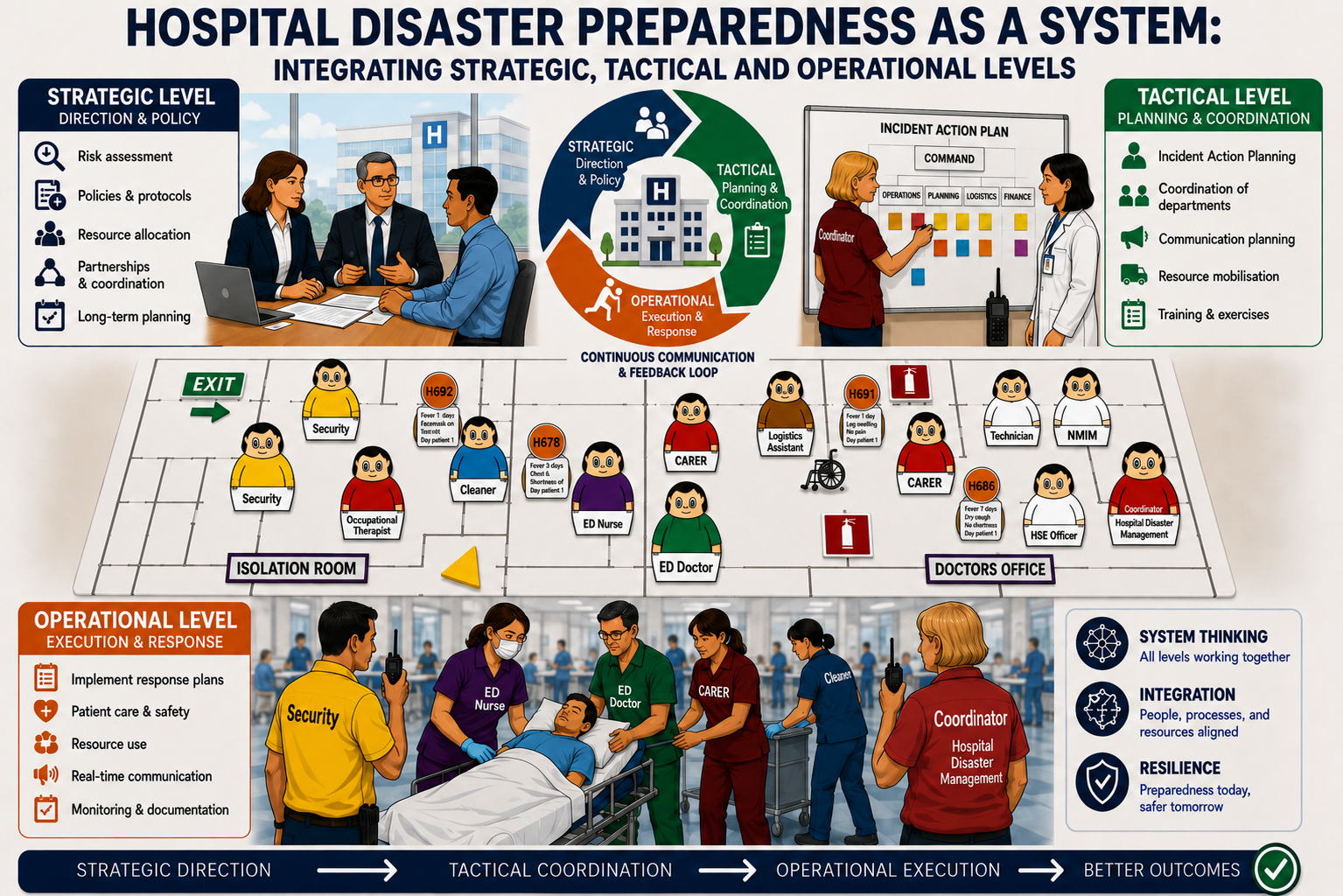
This precourse prepares participants for the main course by providing an overview of hospital disaster preparedness and the interaction between strategic, tactical and operational levels. Emphasis is placed on coordinated decision-making, roles, and responsibilities during major incidents and crises.
Objectives
After completing the precourse, participants will be able to:
- Explain the core principles of hospital disaster preparedness.
- Describe the differences and interdependencies between strategic, tactical, and operational levels.
- Identify key roles and responsibilities at each level.
- Recognise common challenges in communication and coordination during hospital crises.
Learning Format
- Presentations: theory focused on the topic (see table)
- Simulation based tool: Emergo Train System.
As part of the hospital’s preparedness for major incidents and disasters, a multidisciplinary exercise will be conducted. The purpose of this exercise is to evaluate and strengthen coordination, communication, and collaboration between key hospital departments involved in emergency and crisis response.
The following departments will participate in the exercise:
- Triage
- Emergency Department
- Intensive Care Unit
- Operating Room and recovery
- Inpatient Ward
During the exercise, the integrated response to a simulated incident will be practiced, with particular attention to patient flow, capacity management, continuity of care, and interdepartmental decision-making. The exercise will help identify strengths and areas for improvement within the multidisciplinary response and will contribute to the further development and optimisation of the hospital disaster plan.
Faculty
Christel Hendrickx, BE (course director)
- Georgios Leledakis, DE
- Patricia Pires, PT
- Izaskun Tellitu, SP
- Yolanda Villalon, SP
- Saleyha Ahsan, UK
- Sharon Chekijian, US
- Fatine Hamza, FR
For who
- hospital directors and leaders
- clinical, nursing and administrative staff
- emergency coordinators and managers
- response and security teams
- anyone committed to patient safety and community
Educational Material
Online educational material will be provided to the participants in advance
Assessment Methods Evaluation
Course format and pedagogical methods (Aftermath discussion)
- Well balanced and consistently supported by a valid scientific evidence base
- Available for discussion, questions & answers and learner engagement
- Innovative elements
Evaluation
Performance indicators: this refers how learning is measured, not how it is taught. It involves:
- Clear criteria or indicators (e.g. accuracy, speed, quality, application)
- Benchmarks
- Observations of performance or outcomes
Registration
The price for this course is € 350 (including 10% VAT).
Please register through your MyEUSEM account by clicking on the EUSEM Congress registration button. From the Pre-courses tab you can select the pre-courses you would like to join.
| Time | Topic | Faculty |
| 08:00-08:30 | Registration | |
| 08:30-08:45 | Welcome and introduction to WG Hospital Disaster Preparedness (WG HDP), brief introduction of WG HDP members, general goals of the precourse. | WG HDP / Faculty team |
| 08:45-09:15 | Introduction to Hospital Disaster Preparedness (HDP): core principles, types of disasters and crises, and impact on hospital operations and continuity of care. | |
| 09:15-09:45 | Strategic level in hospital disaster preparedness: leadership, governance, policy, decision-making, prioritisation, and external communication. | |
| 09:45-10:15 | Tactical level in hospital disaster preparedness: crisis management teams, coordination, and translating strategy into plans and actions. | |
| 10:15-10:45 | Coffee break and networking | |
| 10:45-11:15 | Operational level in hospital disaster preparedness: frontline execution, capacity management, logistics, patient care, and information flow between levels. | |
| 11:15-12:15 | Patient categorisation: from ward evacuation to full hospital evacuation. ETS demonstration. | Christel Hendrickx |
| 12:15-13:15 | Lunch break | |
| 13:15-13:45 | Presentation on the use of the Emergo Train System (ETS); introduction to the ETS boards and exercise set-up. | Christel Hendrickx |
| 13:45-14:00 | Introduction on the boards of ETS | Instructors |
| 14:00-15:30 | Hospital-wide ETS exercise: multidisciplinary simulation involving triage, Emergency Department, ICU, Operating Room and recovery, inpatient ward, and response cell/runners. | WG HDP |
| 15:30-16:00 | Coffee break | |
| 16:00-16:30 | Evaluation of the exercise: performance review, strengths, areas for improvement, coordination, communication, and patient flow. | WG HDP |
| 16:30-17:00 | Aftermath discussion: discussion, questions and answers, learner engagement, and key take-home messages. | WG HDP |
| 09:00-09:15 | Welcome |
| 09:15-10:00 | Image Acquisition and Instrumentation |
| 10:00-10:30 | Aorta |
| 10:30-11:00 | Coffee Break |
| 11:00-11:45 | Echo in the ED |
| 11:45-12:30 | (eFAST) Examination |
| 12:30-13:30 | Lunch |
| 13:30-14:00 | Vascular Access—central and peripheral lines |
| 14:00-14:45 | Hands-on Session #1 |
| 14:45-15:30 | Hands-on Session #2 |
| 15:30-16:00 | Coffee Break |
| 16:00-16:45 | Hands-on Session #3 |
| 16:45-17:00 | Wrap up and Adjourn |
| 09:00-09:15 | Welcome |
| 09:15-10:00 | Image Acquisition and Instrumentation |
| 10:00-10:30 | Aorta |
| 10:30-11:00 | Coffee Break |
| 11:00-11:45 | Echo in the ED |
| 11:45-12:30 | (eFAST) Examination |
| 12:30-13:30 | Lunch |
| 13:30-14:00 | Vascular Access—central and peripheral lines |
| 14:00-14:45 | Hands-on Session #1 |
| 14:45-15:30 | Hands-on Session #2 |
| 15:30-16:00 | Coffee Break |
| 16:00-16:45 | Hands-on Session #3 |
| 16:45-17:00 | Wrap up and Adjourn |