
Emergency Ultrasound
Format
This pre-course is offered in room 143, at Palais des Congrès de Paris, France on Thursday 24 September, 08:00 -18:00 CEST.
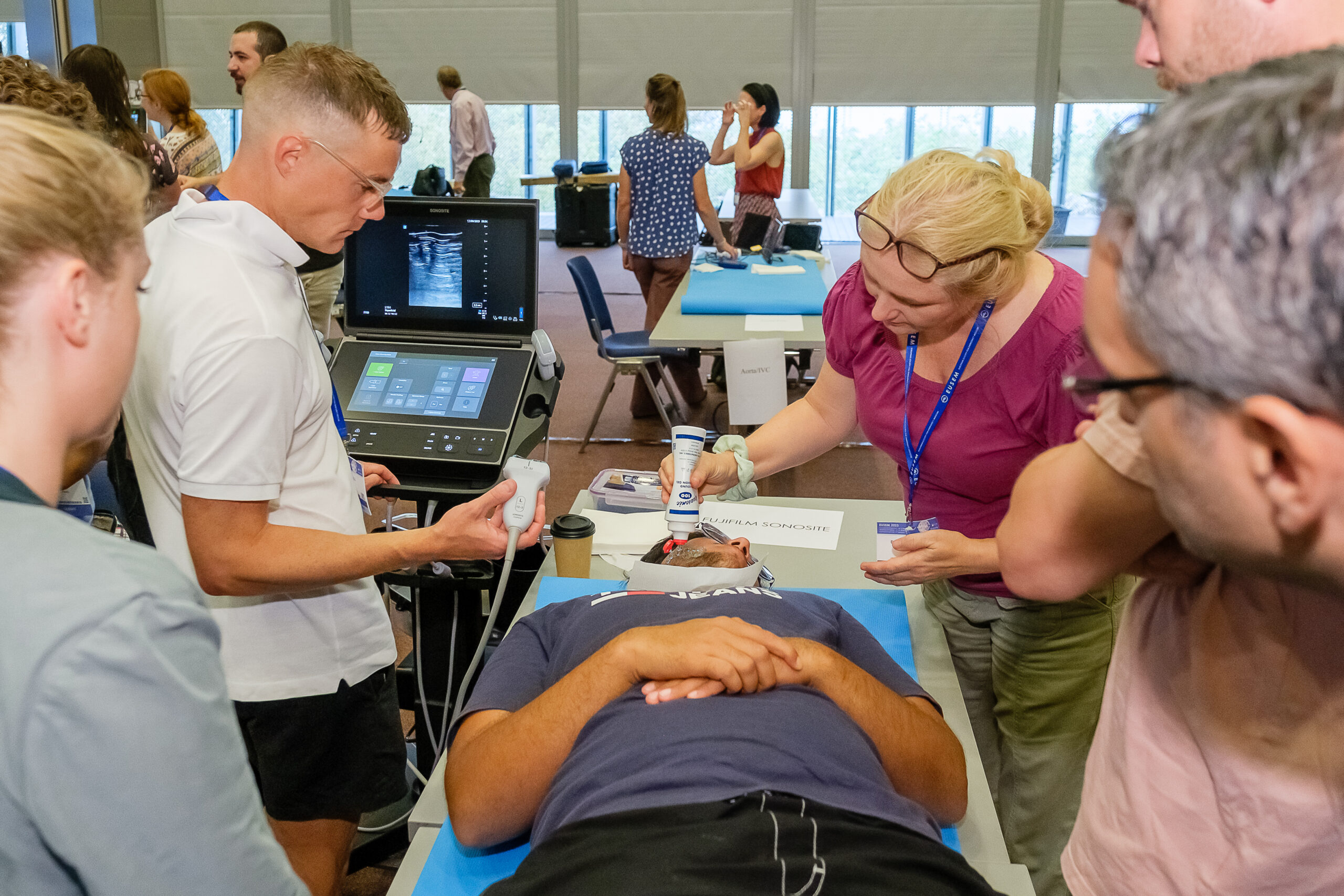
This Point-of-Care Ultrasound (POCUS) training offers a dynamic learning experience for emergency physicians, combining foundational knowledge, hands-on practice, and expert-led instruction. By choosing relevant modules for their individual clinical practice participants will enhance their diagnostic and procedural ultrasound skills, gaining confidence in applying POCUS to improve patient outcomes in emergency care settings.
The course has been accredited by EACCME® and has been awarded a total of 8 CME credits.
For who
Emergency physicians (consultants, trainees, emergency medicine physician assistants), paramedics and nurses.
Module 1 – Ultrasound guided nerve blocks in trauma
This module will provide an introduction to ultrasound guided nerve and fascial plane blocks deemed of high value to emergency physicians in their daily practice. By
providing a foundation to work on, the participant will then be able to apply the principles and skills to any other blocks that are useful in their scope of practice.
Learning Objectives
- Foundations of regional anaesthesia
- know the nerve, see the nerve, see the needle, do the block.
- Practice needling technique including some challenges to test your skills!
- Blocks covered in the module with practical sessions.
- Fascia Iliac compartment blocks for hip fractures–suprainguinal and
infrainguinal.
o Femoral nerve.
o Popliteal.
o Chest wall blocks.- Serratus Anterior Plane.
- Erector Spinae Plane
- Fascia Iliac compartment blocks for hip fractures–suprainguinal and
- Overview of upper limb regional anaesthesiae options
Module 2 – POCUS in musculoskeletal emergencies
This course provides hands-on training in musculoskeletal (MSK) point-of-care ultrasound (POCUS) for joint, tendon, muscle, and soft tissue evaluation relevant for emergency physicians. Participants will learn to identify pathologies, perform ultrasound-guided procedures, and enhance their diagnostic skills.
Learning Objectives
Indications and Clinical Relevance:
- Understand the scope and limitations of ultrasound in musculoskeletal emergency presentations.
- Select appropriate indications for focused MSK ultrasound, especially for traumatic, infectious, or inflammatory conditions.
Sterility and Procedural Hygiene
- Master best practices in sterile technique and infection control during ultrasound-guided punctures and aspirations.
Recognition of Common Pathologies:
- Identify joint effusions in major joints:
- Shoulder: anteriorly via the biceps recess and posteriorly over infraspinatus with external rotation.
- Elbow: Fossa olecrani in longitudinal and transverse views.
- Hip: anteriorly at the head–neck junction.
- Knee: suprapatellar recess in both planes.
- Ankle: anterior longitudinal and transverse approaches.
- Diagnose muscle ruptures and tendon injuries:
- Quadriceps and gastrocnemius muscle ruptures.
- Complete Achilles tendon ruptures, including dynamic assessment in prone position.
- Distinguish soft tissue masses:
- Differentiate abscesses, hematomas, seromas, and other superficial swellings.
- Detect and localize foreign bodies using high-resolution linear probes.
- Distinguish soft tissue masses:
- Differentiate abscesses, hematomas, seromas, and other superficial swellings.
- Detect and localize foreign bodies using high-resolution linear probes.
Ultrasound-Guided Procedures
- Ultrasound guided aspiration of effusions in:
- Shoulder
- Elbow
- Hip
- Knee
- Ankle
- Ultrasound guided foreign body removal
- Execute ultrasound-guided tibial nerve blocks as a pain management strategy for foot sole foreign body removal
Module 3 – Basic focused cardiac POCUS for emergency physicians
In this module, designed specifically for emergency physicians, we explore the
theoretical and practical aspects of cardiac ultrasound. Participants will learn basic
anatomy and views, work on hand-eye coordination, interpret ultrasound findings
comparing normal and pathological images, and integrate results into clinical reasoning
in time-sensitive pathologies.
Learning Objectives
- getting familiar with basic cardiac views and describing the relevant anatomy of
- every view: subcostal, parasternal long and short axis, apical four, five and two
chamber view - name different regions of the left ventricular muscle and describe different basic
ways to assess the contractility - assess left ventricular contractility in different views by eyeballing
- compare and measure chamber size in A4C view
- assess the size of the right ventricle and motion of the septum in diQerent views
- IVC measurement pitfalls and interpretation
- pericardial effusion and tamponade
Module 4 – Advanced focused cardiac POCUS for emergency physicians
Participants will delve into advanced techniques, mastering, including comprehensive, semi-quantitative and even quantitative assessment of cardiac function, identification of structural abnormalities, and evaluation of hemodynamic status. By the end of the course, participants will be taught on tips for integrating all of these applications into their daily clinical practice for critical decision-making in urgent scenarios.
Learning Objectives
- Assess left ventricular systolic function using multiple echocardiographic views, including visual estimation, MAPSE, EPSS, and quantitative methods such as Teichholz and Simpson.
- Evaluate the mitral valve in B-mode and with colour Doppler to identify severe mitral regurgitation.
- Assess right ventricular systolic function using chamber size, TAPSE, and septal motion, and distinguish features suggestive of chronic right ventricular strain.
- Measure tricuspid regurgitation jet velocity (TRV) and pulmonary acceleration time (PAT) in the assessment of suspected pulmonary embolism.
- Measure LVOT VTI to calculate cardiac output and assess haemodynamic changes during a passive leg raise test.
- Learn the principles and technique of echocardiography-guided pericardiocentesis.
Faculty
Course Director: Dr. Senad Tabakovic, (CH)
Co-Directors: Dr. Eftychia Polyzogopoulou (GRC) and Paul Van Overbeeke (NL)
- Tomas Villen
- Lorang Felix
- Majeed Azam
- Keranovic Adis
- Nassralah Nagib
- Ivan Gornik
- Berdouk Sabrina
- Abdolghader Paknyat
- Cardenas Linder
- Grinna Mats
- Aslaner Mehmet Ali
- Haesendonck Ruben
- Chris Yap
- Chin Eric
- Osterwalder Joseph
- Radulovic Bojana
- Croft Peter
- Matthies Ashley
- Cloete David
- Hoffmann Beatrice
- Bajic Slaven
- Atesli Zeki
- Sukul Prem
- Patrick Kishi
Registration
Each participant may select either one module for half a day or two modules for full day.
The price for 1/2 day is € 275 (including 10% VAT)
The price for full day is € 475 (including 10% VAT)
Please register through your MyEUSEM account by clicking on the EUSEM Congress registration button. From the Pre-courses tab you can select the pre-courses you would like to join.
Programme
Module 1 and module 3 are running in parallel. Module 2 and module 4 are running in parallel.
- Thursday 24 September – Module 1
- Thursday 24 September – Module 2
- Thursday 24 September – Module 3
- Thursday 24 September – Module 4
Module 1 – Ultrasound guided nerve blocks in trauma
| Time | 24 September | Faculty |
| 08:15-08:30 | Intro to the day and Needling top tips | Paul van Overbeeke, Eric Chin, Joseph Osterwalder, Bojana Radulovic, Peter Croft, Senad Tabakovic, Ashley Matthies, David Cloete, Beatrice Hoffman, Zeki Atesli, Prem Sukul |
| 08:30-09:30 | Needling challenges (hands on) | Paul van Overbeeke, Eric Chin, Joseph Osterwalder, Bojana Radulovic, Peter Croft, Senad Tabakovic, Ashley Matthies, David Cloete, Beatrice Hoffman, Zeki Atesli, Prem Sukul |
| 09:30-09:45 | Blocks for lower limb fractures | Paul van Overbeeke, Eric Chin, Joseph Osterwalder, Bojana Radulovic, Peter Croft, Senad Tabakovic, Ashley Matthies, David Cloete, Beatrice Hoffman, Zeki Atesli, Prem Sukul |
| 09:45-10:45 | Hands on | Paul van Overbeeke, Eric Chin, Joseph Osterwalder, Bojana Radulovic, Peter Croft, Senad Tabakovic, Ashley Matthies, David Cloete, Beatrice Hoffman, Zeki Atesli, Prem Sukul |
| 10:45-11:00 | Coffee Break | |
| 11:00-11:15 | Chest wall injuries blocks | Paul van Overbeeke, Eric Chin, Joseph Osterwalder, Bojana Radulovic, Peter Croft, Senad Tabakovic, Ashley Matthies, David Cloete, Beatrice Hoffman, Zeki Atesli, Prem Sukul |
| 11:15-12:15 | Hands on | Paul van Overbeeke, Eric Chin, Joseph Osterwalder, Bojana Radulovic, Peter Croft, Senad Tabakovic, Ashley Matthies, David Cloete, Beatrice Hoffman, Zeki Atesli, Prem Sukul |
| 12:15-12:30 | Upper Limb RA options and Close | Paul van Overbeeke, Eric Chin, Joseph Osterwalder, Bojana Radulovic, Peter Croft, Senad Tabakovic, Ashley Matthies, David Cloete, Beatrice Hoffman, Zeki Atesli, Prem Sukul |
Module 2 – Ultrasound in musculoskelettal emergencies
| Time | 24 September | Faculty |
| 13:30-13:35 | Welcome and Introduction | Senad Tabakovic, Zeki Atesli, Paul Van Overbeeke, Eric Chin, Joseph Osterwalder, Azam Majeed, Bojana Radulovic, Peter Croft, Adis Keranovic, Nagib Nassralah, Ashley Matthies, Prem Sukul, Patrick Kishi |
| 13:35-13:50 | Knee Effusion/Aspiration, Patellar Tendon Rupture, Quadriceps Tendon Rupture; Hip effusion/aspirationn | Senad Tabakovic, Zeki Atesli, Paul Van Overbeeke, Eric Chin, Joseph Osterwalder, Azam Majeed, Bojana Radulovic, Peter Croft, Adis Keranovic, Nagib Nassralah, Ashley Matthies, Prem Sukul, Patrick Kishi |
| 13:50-14:40 | Scanning | Senad Tabakovic, Zeki Atesli, Paul Van Overbeeke, Eric Chin, Joseph Osterwalder, Azam Majeed, Bojana Radulovic, Peter Croft, Adis Keranovic, Nagib Nassralah, Ashley Matthies, Prem Sukul, Patrick Kishi |
| 14:40-14:55 | Ankle and Lower Leg (Achilles Tendon Rupture, Ankle Effusion/Aspiration, Syndesmosis Rupture, Distal Malleolar Fractures, Medial Gastrocnemius Rupture) | Senad Tabakovic, Zeki Atesli, Paul Van Overbeeke, Eric Chin, Joseph Osterwalder, Azam Majeed, Bojana Radulovic, Peter Croft, Adis Keranovic, Nagib Nassralah, Ashley Matthies, Prem Sukul, Patrick Kishi |
| 14:55-15:45 | Scanning | Senad Tabakovic, Zeki Atesli, Paul Van Overbeeke, Eric Chin, Joseph Osterwalder, Azam Majeed, Bojana Radulovic, Peter Croft, Adis Keranovic, Nagib Nassralah, Ashley Matthies, Prem Sukul, Patrick Kishi |
| 15:45-16:00 | Coffee break | |
| 16:00-16:15 | Shoulder and Elbow (Effusion/Aspiration, Shoulder Dislocation, Biceps Tendon Rupture, Supraspinatus Tendon and Subacromial Bursa Infiltration) | Senad Tabakovic, Zeki Atesli, Paul Van Overbeeke, Eric Chin, Joseph Osterwalder, Azam Majeed, Bojana Radulovic, Peter Croft, Adis Keranovic, Nagib Nassralah, Ashley Matthies, Prem Sukul, Patrick Kishi |
| 16:15-17:00 | Scanning | Senad Tabakovic, Zeki Atesli, Paul Van Overbeeke, Eric Chin, Joseph Osterwalder, Azam Majeed, Bojana Radulovic, Peter Croft, Adis Keranovic, Nagib Nassralah, Ashley Matthies, Prem Sukul, Patrick Kishi |
| 17:00-17:15 | Soft Tissue Swelling and US-Guided Foreign Body Removal, Tibialis Posterior Block | Senad Tabakovic, Zeki Atesli, Paul Van Overbeeke, Eric Chin, Joseph Osterwalder, Azam Majeed, Bojana Radulovic, Peter Croft, Adis Keranovic, Nagib Nassralah, Ashley Matthies, Prem Sukul, Patrick Kishi |
| 17:15-18:00 | Scanning and close | Senad Tabakovic, Zeki Atesli, Paul Van Overbeeke, Eric Chin, Joseph Osterwalder, Azam Majeed, Bojana Radulovic, Peter Croft, Adis Keranovic, Nagib Nassralah, Ashley Matthies, Prem Sukul, Patrick Kishi |
Module 3 – Basic focused cardiac POCUS for emergency physicians
| Time | 24 September | Faculty |
| 08:15-08:25 | Introduction | Patrick Kishi, Felix Lorang, Azam Majeed, Adis Keranovic, Nagib Nassralah, Ivan Gornik, Sabrina Berdouk, Abdolghader Paknyat, Linder Cardenas, Grinna Mats, Ali Mehmet Aslaner, Ruben Haesendonck |
| 08:25-08:40 | Basic views: SX, PLAX, PSAX, A4 and IVC | Patrick Kishi, Felix Lorang, Azam Majeed, Adis Keranovic, Nagib Nassralah, Ivan Gornik, Sabrina Berdouk, Abdolghader Paknyat, Linder Cardenas, Grinna Mats, Ali Mehmet Aslaner, Ruben Haesendonck |
| 08:40-09:40 | Hands on | Patrick Kishi, Felix Lorang, Azam Majeed, Adis Keranovic, Nagib Nassralah, Ivan Gornik, Sabrina Berdouk, Abdolghader Paknyat, Linder Cardenas, Grinna Mats, Ali Mehmet Aslaner, Ruben Haesendonck |
| 09:40-09:55 | LV basic assessment | Patrick Kishi, Felix Lorang, Azam Majeed, Adis Keranovic, Nagib Nassralah, Ivan Gornik, Sabrina Berdouk, Abdolghader Paknyat, Linder Cardenas, Grinna Mats, Ali Mehmet Aslaner, Ruben Haesendonck |
| 09:55-10:25 | RV basic assessment | Patrick Kishi, Felix Lorang, Azam Majeed, Adis Keranovic, Nagib Nassralah, Ivan Gornik, Sabrina Berdouk, Abdolghader Paknyat, Linder Cardenas, Grinna Mats, Ali Mehmet Aslaner, Ruben Haesendonck |
| 10:25-10:40 | Coffee break | |
| 10:40-11:40 | Hands on | Patrick Kishi, Felix Lorang, Azam Majeed, Adis Keranovic, Nagib Nassralah, Ivan Gornik, Sabrina Berdouk, Abdolghader Paknyat, Linder Cardenas, Grinna Mats, Ali Mehmet Aslaner, Ruben Haesendonck |
| 11:40-11:55 | Pericardial effusion and tamponde | Patrick Kishi, Felix Lorang, Azam Majeed, Adis Keranovic, Nagib Nassralah, Ivan Gornik, Sabrina Berdouk, Abdolghader Paknyat, Linder Cardenas, Grinna Mats, Ali Mehmet Aslaner, Ruben Haesendonck |
| 11:55-12:40 | Hands on and close | Patrick Kishi, Felix Lorang, Azam Majeed, Adis Keranovic, Nagib Nassralah, Ivan Gornik, Sabrina Berdouk, Abdolghader Paknyat, Linder Cardenas, Grinna Mats, Ali Mehmet Aslaner, Ruben Haesendonck |
Module 4 – Advanced focused cardiac POCUS for emergency physicians
| Time | 24 September | Faculty |
| 13:30-13:40 | Introduction | Ruben Haesendonck, Sabrina Berdouk, Paknyat Abdolghader, Ivan Gornik, Linder Cardenas, Slaven Bajic, Mats Grinna, Ali Mehmet Aslaner, Tomas Villen, David Cloete, Effie Polyzogopoulou, Beatrice Hoffman, Felix Lorang |
| 13:40-13:55 | Doppler for emergency physicians: C, PW, Cw, TDI | Ruben Haesendonck, Sabrina Berdouk, Paknyat Abdolghader, Ivan Gornik, Linder Cardenas, Slaven Bajic, Mats Grinna, Ali Mehmet Aslaner, Tomas Villen, David Cloete, Effie Polyzogopoulou, Beatrice Hoffman, Felix Lorang |
| 13:55-14:10 | Advanced LV systolic assessment | Ruben Haesendonck, Sabrina Berdouk, Paknyat Abdolghader, Ivan Gornik, Linder Cardenas, Slaven Bajic, Mats Grinna, Ali Mehmet Aslaner, Tomas Villen, David Cloete, Effie Polyzogopoulou, Beatrice Hoffman, Felix Lorang |
| 14:10-14:25 | Advanced RV systolic assessment | Ruben Haesendonck, Sabrina Berdouk, Paknyat Abdolghader, Ivan Gornik, Linder Cardenas, Slaven Bajic, Mats Grinna, Ali Mehmet Aslaner, Tomas Villen, David Cloete, Effie Polyzogopoulou, Beatrice Hoffman, Felix Lorang |
| 14:25-15:25 | Hands on | Ruben Haesendonck, Sabrina Berdouk, Paknyat Abdolghader, Ivan Gornik, Linder Cardenas, Slaven Bajic, Mats Grinna, Ali Mehmet Aslaner, Tomas Villen, David Cloete, Effie Polyzogopoulou, Beatrice Hoffman, Felix Lorang |
| 15:25-15:40 | Coffee break | |
| 15:40-15:55 | Basic hemodynamics: from VTI to CO | Ruben Haesendonck, Sabrina Berdouk, Paknyat Abdolghader, Ivan Gornik, Linder Cardenas, Slaven Bajic, Mats Grinna, Ali Mehmet Aslaner, Tomas Villen, David Cloete, Effie Polyzogopoulou, Beatrice Hoffman, Felix Lorang |
| 15:55-16:55 | Hands on | Ruben Haesendonck, Sabrina Berdouk, Paknyat Abdolghader, Ivan Gornik, Linder Cardenas, Slaven Bajic, Mats Grinna, Ali Mehmet Aslaner, Tomas Villen, David Cloete, Effie Polyzogopoulou, Beatrice Hoffman, Felix Lorang |
| 16:55-17:10 | Echo guided pericardiocentesis | Ruben Haesendonck, Sabrina Berdouk, Paknyat Abdolghader, Ivan Gornik, Linder Cardenas, Slaven Bajic, Mats Grinna, Ali Mehmet Aslaner, Tomas Villen, David Cloete, Effie Polyzogopoulou, Beatrice Hoffman, Felix Lorang |
| 17:10-18:00 | Hands on Interactive cases and close | Ruben Haesendonck, Sabrina Berdouk, Paknyat Abdolghader, Ivan Gornik, Linder Cardenas, Slaven Bajic, Mats Grinna, Ali Mehmet Aslaner, Tomas Villen, David Cloete, Effie Polyzogopoulou, Beatrice Hoffman, Felix Lorang |