
Advanced Paediatric Emergency Care (APEC)
Format – on site
This course will be offered on Thursday 24 September, at 8:30 – 18:00 CEST, in room 141, at Palais des Congrès de Paris, Paris, France.
Overview
This course is developed by the Paediatric Branch of the European Society for Emergency Medicine. The branch wants to promote and facilitate the dissemination of knowledge in PEM in Europe and the world through meetings, courses, research, publications, and various clinical activities.
The course has been accredited by EACCME® and has been awarded a total of 6 CME credits.
As we are marking 20 years of running this pre-course, we have evolved through several phases and are now aiming for a more integrated and modern learning approach.
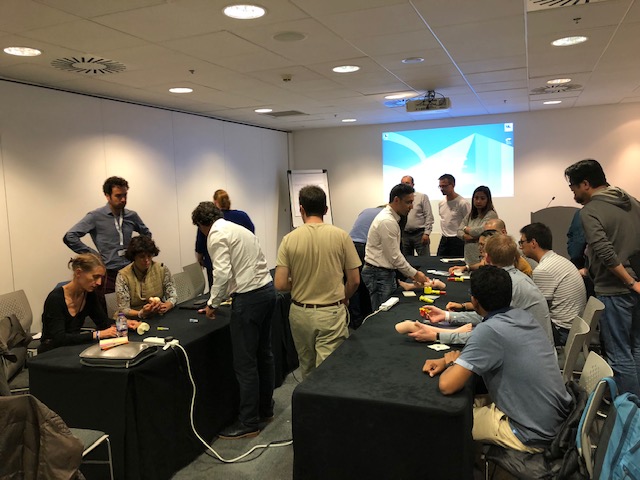
This pre-course delivers a dynamic, engaging, and immersive learning experience built around progressive learning layers
The result is a high-energy, learner-centered experience that integrates knowledge, technical skills, systems awareness, and teamwork.
We will also provide registered participants with access to affinity learning modules as part of the pre-learning phase for APEC.
Objective
The overarching goal of this pre-course is to strengthen clinical confidence, decision-making, and teamwork in pediatric emergency care, particularly during the first critical minutes of assessment and stabilization. Integrating cutting-edge didactics, immersive simulation, human factors training, and system-based problem solving.
Learning outcomes
Ultimately, the course aims to translate learning into better preparedness, safer care, and improved outcomes for critically ill and injured children.
Programme
The programme consists of:
- Lectures on how to recognise a sever sick child
- Paediatric assessment triangle
- ABCDE
- Reel cases and challenging approaches
- Challenging the audience (based on their experiences)
- Providing evidence medicine on specific topics
- Small discussion groups
Educational material
Pre-course resources
- Short micro-didactic video modules
- Readiness quiz (Poll Everywhere)
- Participant guide with key learning themes
During the course
- Tabletop simulation maps and tools
- Case pearls and decision guides
- Skill station quick reference cards
For who
This pre-course is designed for all clinicians involved in the emergency and acute care of children—including pediatric emergency physicians, general emergency physicians, pediatricians, anesthesiologists, intensivists, trainees, nurses, paramedics, and allied health professionals. Whether experienced or early-career, participants will benefit from practical, high-impact learning focused on real-world pediatric emergencies
Faculty
Course Director: Prof Said Hachimi-Idrissi, BE
Co-director: Dr Jabeen Fayyaz, CA
- Dr Naveen Poonai, CA
- Dr Najib Nasrallah, IL
- Dr Nordia Thompson-Newell, JM
- Dr Nitai Levy, IL
- Dr Dave Walker, US
- Dr Muhamed Elhady Muhammed ELGASIM, IE
Registration
The price for this course is € 350 (including 10% VAT)
Please register through your MyEUSEM account by clicking on the EUSEM Congress registration button. On the pre-course tab you can select the pre-courses you would like to join.
| Time | Topic | Faculty |
| 08:00-08:30 | Registration | |
| 08:30-09:00 | Welcome and Introduction | |
| 09:00-09:30 | Overview of course objectives, agenda Pediatric Assessment Triangle (PAT) | Said Hachimi-Idrissi |
| 09:30-10:30 | Tabletop Simulation (rotation system every 25 min; 4 groups) Group 1: Pediatric sepsis with evolving complexity: Septic Shock, Cardiogenic Shock Group 2: Pediatric Trauma preparation, priorities and latent safety threats: Head Injury, Neck Injuries | Said Hachimi-Idrissi Nordia Thompson-Newell Nitai Levy Naveen Poonai |
| 10:30-11:00 | Coffee Break | |
| 11:00-12:00 | Tabletop Simulation (rotation system every 25 min; 4 groups) continues Group 3: Pediatric Status Epilepticus Group 4: Pediatric Airway management: Croup/ Asthma, RSI | Jabeen Fayyaz Muhammed Elhady Muhammed El Gasim Dave Walker Najib Nasrallah |
| 12:00-13:00 | Neonatal boot (rotation in 2 groups) Group 1: “A neonate with subtle red flags”: NNL sepsis, NNL Hypoglycemia Group 2: The “First 5 Minutes of Stabilization in neonatology”: NNL Resuscitation for Term and Preterm babies | Jabeen Fayyaz Nordia Thomspon-Newell Said Hachimi-Idrissi Dave Walker |
| 13:00-14:00 | Lunch Break | |
| 14:00-14:30 | Skill Stations (Rapid 8-10 Minute Circuits): Airway basics Vascular access Pediatric sepsis | Dave Walker Nitai Levy Jabeen Fayyaz |
| 14:30-15:00 | Skill Stations (Rapid 8-10 Minute Circuits): Splinting Control of Bleeding MHP/ Hemorrhagic shock Airway management in traumatic child | Muhammed Elhady El Gasim Said Hachimi-Idrissi Nordia Thompson-Newell |
| 15:00-15:30 | Coffee Break | |
| 15:30-17:00 | POCUS hands on (rotation in 2 groups) Group 1: POCUS essentials: Respiratory evaluation Group 2: POCUS essentials: circulatory evaluation | Nitai Levy Najib Nasrallah |
| 17:00-17:30 | Final Wrap-Up, discussion and key learning points | |
| 17:30-18:00 | Participant feedback |